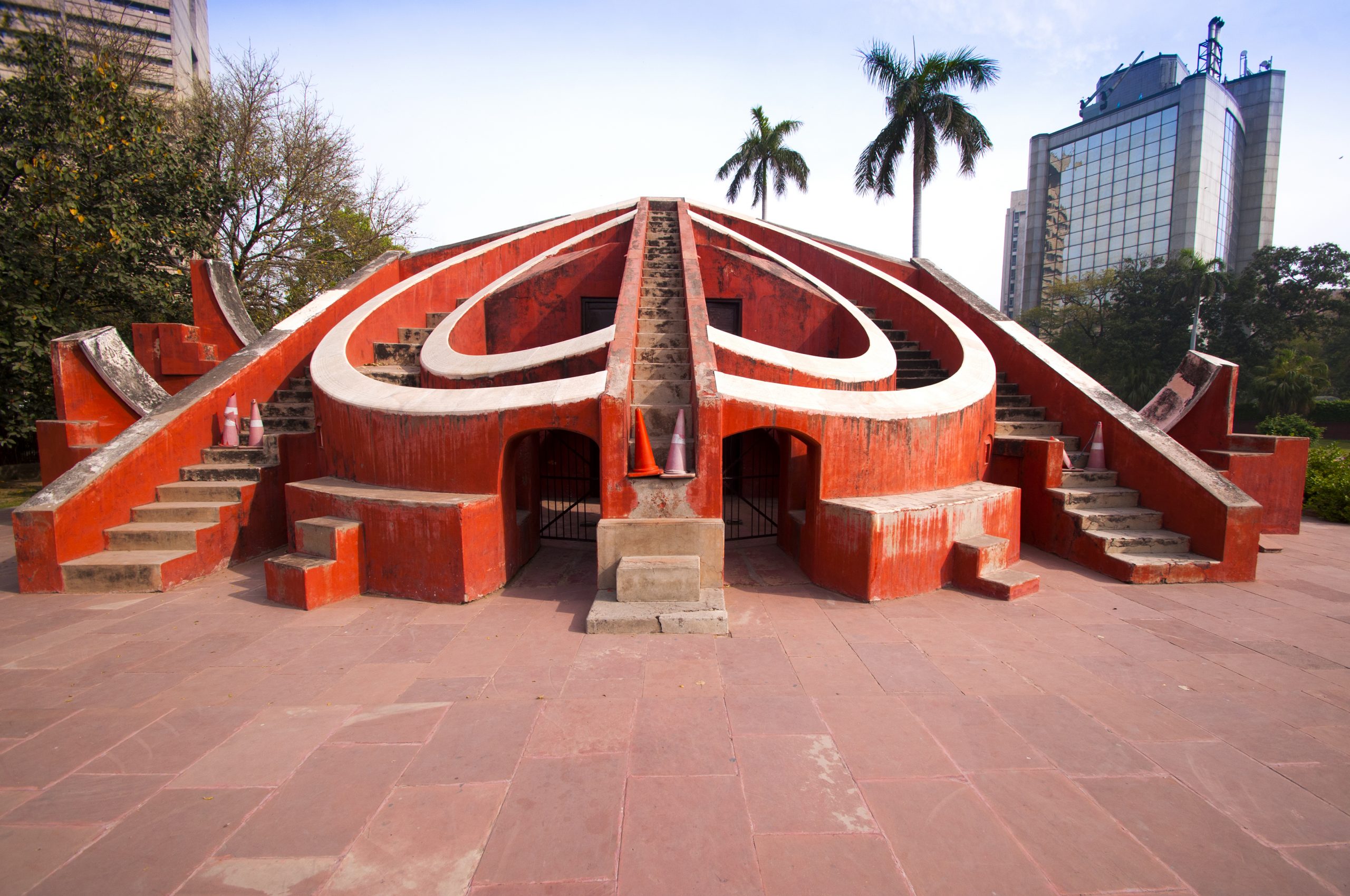
Jantar Mantar Delhi is a remarkable open-air astronomical observatory located in the heart of New Delhi. It stands as a stunning monument to India’s scientific heritage, blending mathematics, astronomy, and architecture. Constructed long before the advent of modern telescopes, this UNESCO World Heritage Site remains one of the city’s most fascinating historical landmarks.
Location and How to Reach Jantar Mantar Delhi
- Address: Sansad Marg, Connaught Place, New Delhi, Delhi 110001.
- Nearest Metro Station: Rajiv Chowk (Blue and Yellow Lines) or Janpath (Violet Line). Both are within a 10–12 minute walk from the monument.
- By Bus: Well-connected by Delhi Transport Corporation (DTC) buses stopping at Connaught Place or Palika Kendra.
- By Cab/Auto: Easily accessible via ride-sharing apps or local auto-rickshaws from any part of central Delhi.
Jantar Mantar Delhi Visitor Information
- Timings: Open daily from 6:00 AM to 6:00 PM (Sunrise to Sunset).
- Best Time to Visit: October to March offers pleasant weather for walking around the outdoor complex.
- Mid-Day Advantage: Visiting around noon allows you to see the sun casts vertical shadows, making it easier to understand how the instruments measure time.
- Entry Fee: Nominal fee for Indian citizens; higher rate for international tourists (cashless payment options are available at the counter).
Historical Importance of Jantar Mantar Delhi
- The Visionary Founder: Built in 1724 by Maharaja Jai Singh II of Jaipur.
- The Royal Mandate: Commissioned by Mughal Emperor Muhammad Shah to rectify existing astronomical tables and reform the calendar.
- Scientific Precision: Designed to measure time, track the movements of the sun, moon, and planets, and predict eclipses with remarkable accuracy.
- One of Five: Delhi’s observatory is the first of five built by Jai Singh II across Northern India (the others being in Jaipur, Varanasi, Ujjain, and Mathura).
The Architectural Marvels: Key Instruments
Jantar Mantar Delhi features 13 architectural astronomy instruments across four major standalone structural complexes and various specialized sub-components. Rather than 13 completely separate buildings, Maharaja Jai Singh II grouped several mathematically distinct calculation tools into shared masonry layouts.
The Samrat Yantra Complex (2 Instruments)
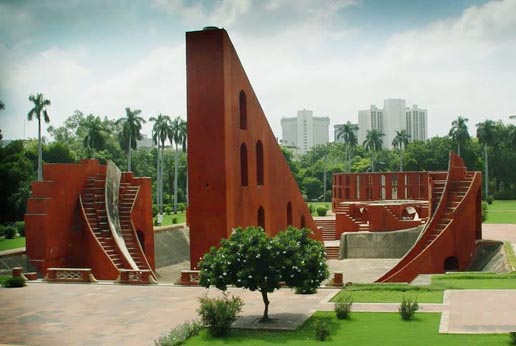
The main structure stands parallel to the Earth’s axis. It functions as a massive, equal-hour sundial.
- The Equinoctial Dial: A massive central triangular gnomon. The wall casts a shadow onto graduated marble quadrants to tell local time with two-second precision.
- Shasthansa Yantra: Built directly within the towers supporting the quadrant scales. It uses a pinhole camera mechanism to project an image of the sun, measuring its zenith, declination, and diameter at noon.
The Misra Yantra Complex (5 Instruments)
The “mixed instrument” structure blends five distinct calculating devices into one heart-shaped architectural facade.
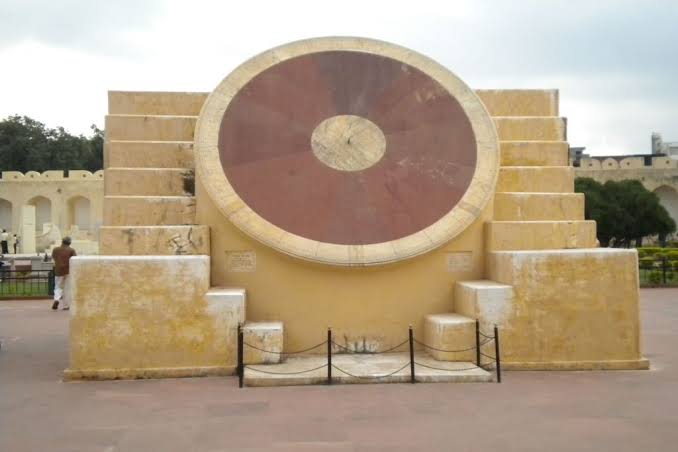
- Daksinottra Bhitti: A modified wall instrument used to calculate the precise zenith distance and altitude of celestial bodies crossing the meridian.
- Samrat Yantra (Miniature): A scaled-down version of the main sundial built into the center to measure time locally.
- Niyat Chakra: A set of four semi-circular dials flanking the central gnomon. They mirror the sun’s position to signal exact noon for foreign observatories like Greenwich, Zurich, Notkey (Japan), and Serichew.
- Karkarasi Valaya: A specialized coordinate ring calibrated to trace the exact moment the sun enters the Cancer zodiac constellation.
- Palabha Yantra: A compact horizontal dial assembly designed to determine the precise latitude of Delhi by measuring shadows at the equinox.
The Jaya Prakash Yantra Complex (2 Instruments)
This design features two hollowed-out hemispherical bowls sunk directly into the ground.
- The Day Map Bowl: Marked with a grid system on its concave surface. Taut crosswires suspended above hold a small metal ring that tracks the sun’s movement via its daytime shadow.
- The Night Map Bowl: A complementary, inverted bowl with identical star coordinates. An astronomer stands inside the cutout pathways at night, aligning their line of sight through the crosswires to map stellar coordinates.
The Ram Yantra Complex (2 Instruments)
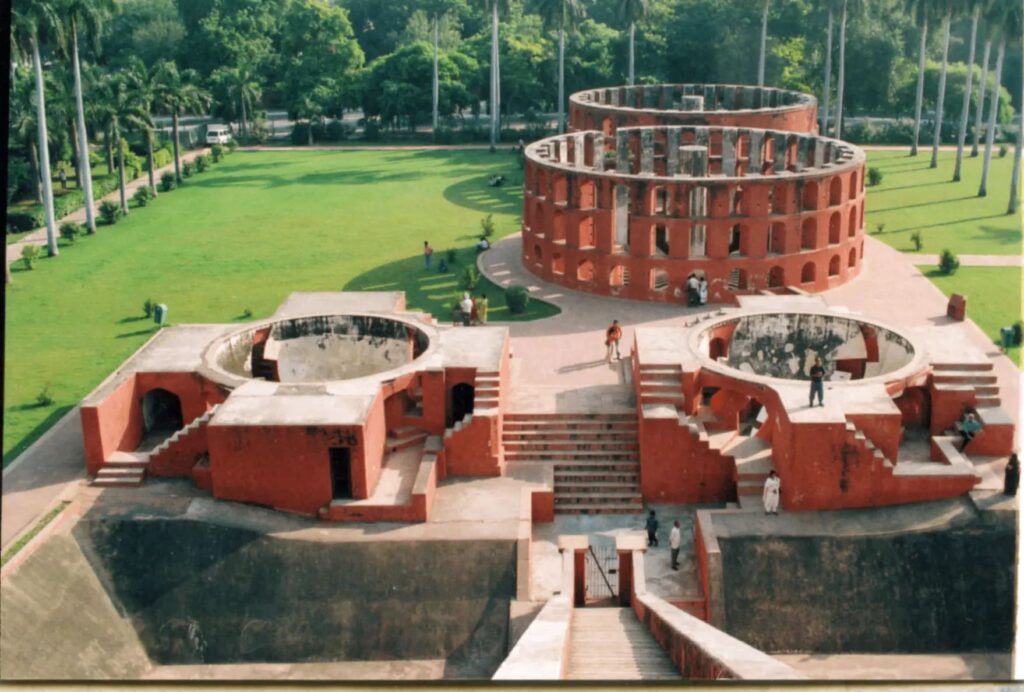
This instrument consists of two open-top cylindrical structures. They are placed apart to measure coordinates without blind spots.
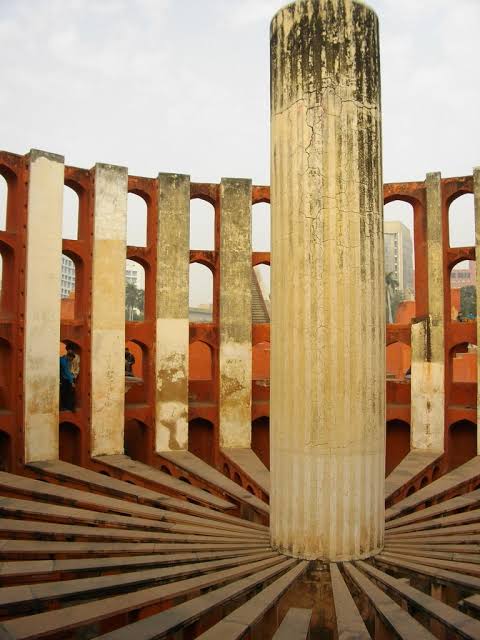
- The Azimuth Pillar & Floor Scales: A central stone pillar inside a circular wall grid. It tracks horizontal coordinate angles (azimuth) from sunrise to sunset.
- The Altitude Radial Sectors: Alternating stone slabs and open spaces climbing the inner walls. These measure the exact vertical angle (altitude) of stars and planets above the horizon.
Auxiliary Coordinate Instruments (2 Instruments)
- Kapala Yantra: Built on the same principle as the Jaya Prakash. This smaller bowl acts as a training and demonstration tool to convert celestial paths between different coordinate systems.
- Rasivalya Yantra: A specialized coordinate plane integrated near the base grids. It measures the latitude and longitude of zodiac signs at the precise moment they cross the local meridian line.
Current Importance and Cultural Significance
- A Symbol of Protest: Beyond astronomy, the outer perimeter of Jantar Mantar has historically served as Delhi’s designated site for peaceful democratic protests, rallies, and social movements.
- Photographer’s Paradise: The striking geometric shapes, deep red color tones, and stark shadows make it a favorite spot for architectural photographers and history enthusiasts.
- Educational Hub: Jantar Mantar Delhi regularly hosts school excursions, serving as a practical laboratory to teach students the ancient methods of astronomy and geometry.
Top 5 successful protests staged at Jantar Mantar Delhi
Jantar Mantar Delhi has served as primary venue for democratic dissent since 1993, witnessing major civic movements that successfully influenced national legislation and government accountability. After demonstrations were banned at India Gate’s Boat Club, this 300-year-old astronomical site transitioned into India’s most iconic protest hub.
The top five most impactful and successful movements staged at Jantar Mantar Delhi include:
The Gen-Z CJP Student Reforms Agitation (July 2026)
- The Cause: Widespread student anger surrounding alleged paper leaks, student’s suicide and systemic irregularities in national competitive exams like NEET and CUET.
- The Action: Led by Abhijeet Dipke and the Cockroach Janta Party (CJP), thousands of students camped at Jantar Mantar alongside Ladakhi activist Sonam Wangchuk, who joined with an indefinite hunger strike.

- The Outcome: Following weeks of intense demonstration and public pressure, the movement forced a major political breakthrough when Union Education Minister Dharmendra Pradhan officially resigned on July 25, 2026, leading to direct government compliance with structural exam reform demands.
The Landmark Legal Fight to Protect the Protest Site Itself (2018)
- The Cause: A National Green Tribunal (NGT) order that placed a blanket ban on all protests at Jantar Mantar, citing noise pollution and traffic disruptions for local residents.
- The Action: Civil rights groups, activists, and unions launched legal challenges against the shutdown of Delhi’s central democratic space.
- The Outcome: In July 2018, the Supreme Court of India issued a landmark judgment overturning the ban. The apex court officially ruled that the right to peaceful protest at Jantar Mantar is a fundamental right that cannot be entirely suppressed by administrative convenience.
One Rank One Pension (OROP) Agitation (2015)
- The Cause: Military veterans demanding a uniform pension system where retired soldiers of the same rank receive equal payouts regardless of their retirement date.
- The Action: Ex-servicemen staged a continuous relay hunger strike and held massive rallies directly on the pavement of Jantar Mantar.
- The Outcome: The prolonged visibility of the protest pushed the Ministry of Defence to concede to the veterans’ demands, resulting in the official implementation of the OROP scheme for over two million retirees.
Justice for Nirbhaya / Criminal Law Amendments (2012–2013)
- The Cause: Spontaneous public outrage following the brutal December 2012 gang rape of a paramedic student in Delhi.
- The Action: Jantar Mantar became the core base camp for students, women’s rights groups, and citizens who braved police barricades to demand safety reforms.
- The Outcome: The sheer scale of the demonstrations led to the urgent setup of the Justice Verma Committee, resulting in the Criminal Law (Amendment) Act of 2013, which vastly toughened punishments for sexual crimes and fast-tracked trials.
Anna Hazare’s Anti-Corruption Movement (2011)
- The Cause: A massive civil society mobilization demanding an independent ombudsman body to investigate political graft.
- The Action: Activist Anna Hazare launched an indefinite hunger strike at Jantar Mantar, drawing tens of thousands of citizens and massive media attention.
- The Outcome: The sustained pressure forced Parliament to introduce and eventually pass the historic Jan Lokpal and Lokayuktas Act in 2013, establishing statutory anti-corruption authorities.
Unique Tips for Visitors
- Hire a Guide: Consider hiring a certified local guide or downloading an audio guide to truly understand how the complex stone structures calculate time without modern machinery.
- Carry Protection: Because the site is completely outdoors, carry an umbrella, sunglasses, and water, especially if visiting during the warmer months.
- Combine Your Trip: Located right next to Connaught Place, you can easily pair your visit with shopping, dining, or exploring the nearby cultural hub of Janpath.
Jantar Mantar stands as a unique monument in Delhi’s historical landscape. While the soaring Qutub Minar celebrates medieval architectural heights and the grand Red Fort mirrors the zenith of imperial Mughal power, Jantar Mantar captures a different triumph—India’s legacy of scientific reason and intellectual curiosity.
It is a space where stone calculations meet modern democratic expressions. For anyone exploring the historic ruins of Delhi, this outdoor observatory provides a crucial link. It connects the scientific genius of the 18th century directly to the vibrant, living heart of the capital today.


Be First to Comment